Introduction to CSRD: Context and what organisations need to know now

On 3rd July, the European Commission formally adopted the revised ESRS standards, bringing to an end a two-year period of uncertainty for obligated companies.
In this article, we provide an overview of the Corporate Sustainable Reporting Directive (CSRD) and the changes introduced through the Omnibus iterations. We explain how the requirements, reporting timelines and scope criteria have evolved, and highlight the key considerations for organisations assessing their reporting obligations.
What is the CSRD?
The CSRD is a significant EU sustainability reporting framework that aims to create a holistic, transparent and informative reporting environment. It provides investors, regulators, customers and other stakeholders with reliable and comparable ESG information across the European market. The first version of CSRD brought over 50,000 companies into scope, requiring an organisation to assess their double materiality against ~1,100 datapoints.
The initial CSRD timeline
- In 2021, CSRD was developed by the European Commission as part of the wider European Green Deal¹.
- In 2022, political agreement was reached between the European Parliament and Council.
- In 2023, the European Sustainability Reporting Standards (ESRS) were developed by the European Financial Reporting Advisory Group (EFRAG) and formally adopted by the European Commission through a Delegated Regulation.
- In 2024, Member States transposed it into national law.
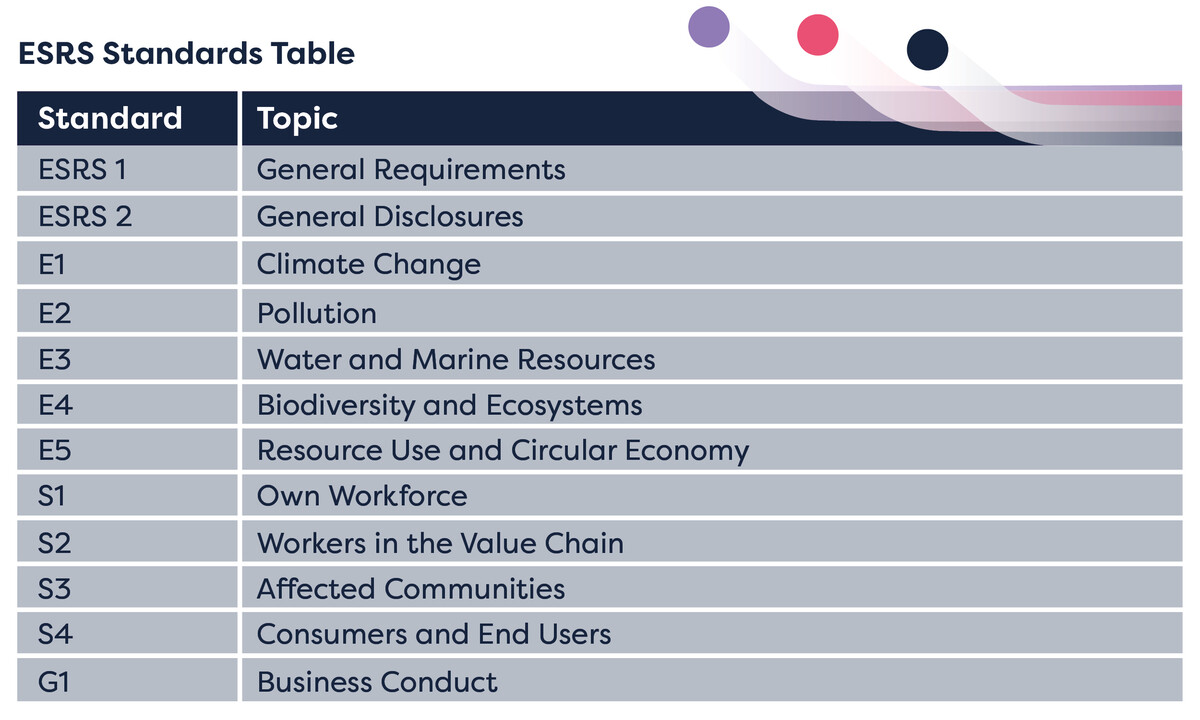
The ESRS standards are designed to help companies disclose consistent and comparable information regarding environmental, social and governance topics.
There are also two general standards. One sets the general requirements for sustainability (ESRS 1) and another defines the mandatory general disclosures that all companies must provide under CSRD (ESRS 2). There are an additional 10 topical standards across ESG, with quantitative and qualitative datapoints that companies must report on following a double materiality assessment (DMA). These are all shown in the table below:
The importance of a Double Materiality Assessment (DMA)
How companies identify which of the above standards they must report on depends on the outcome of their DMA. The DMA assesses:
- Impact materiality: the actual or potential, positive or negative impacts the organisation has on people and the environment.
- Financial materiality: the sustainability-related risks and opportunities that could impact the organisation’s financial position, performance, cash flows, access to finance or cost of capital.
Within the DMA, an organisation must set a materiality threshold that is supported by a robust methodology. If they deem an impact, risk or opportunity to be material, they must disclose the necessary information and datapoints within their sustainability statement.
The Omnibus
In 2025, during the first wave of reporting, it became apparent that many larger companies and Member States had concerns. These included:
- the reporting complexities;
- the significant number of datapoints; and
- the overall reporting burden.
Smaller companies were worried that they would struggle due to generally having weaker data systems and processes, and restricted resources, in comparison to their larger counterparts.
In response, the European Commission decided to review the CSRD requirements. Their aim was to simplify sustainability reporting requirements while preserving the core objective of providing transparent and decision-useful stakeholder information.
The Omnibus timeline
- In February 2025, the European Commission published the Omnibus proposal.
- In April 2025, the ‘stop-the-clock’ mechanism was adopted, delaying reporting timelines for companies in waves 2 and 3. Typically, this covered larger companies who did not report to the Non-Financial Reporting Disclosure (NFDR), listed SME’s and small financial firms.
- During 2025, EFRAG reviewed and simplified the ESRS standards.
- Between December 2025 and February 2026, the revised package was agreed and accepted.
- In March 2026, the revised CSRD entered into force. Member States have until March 2027 to transpose it into national law.
- In July 2026, revised ESRS standards were formally adopted by the Commission.
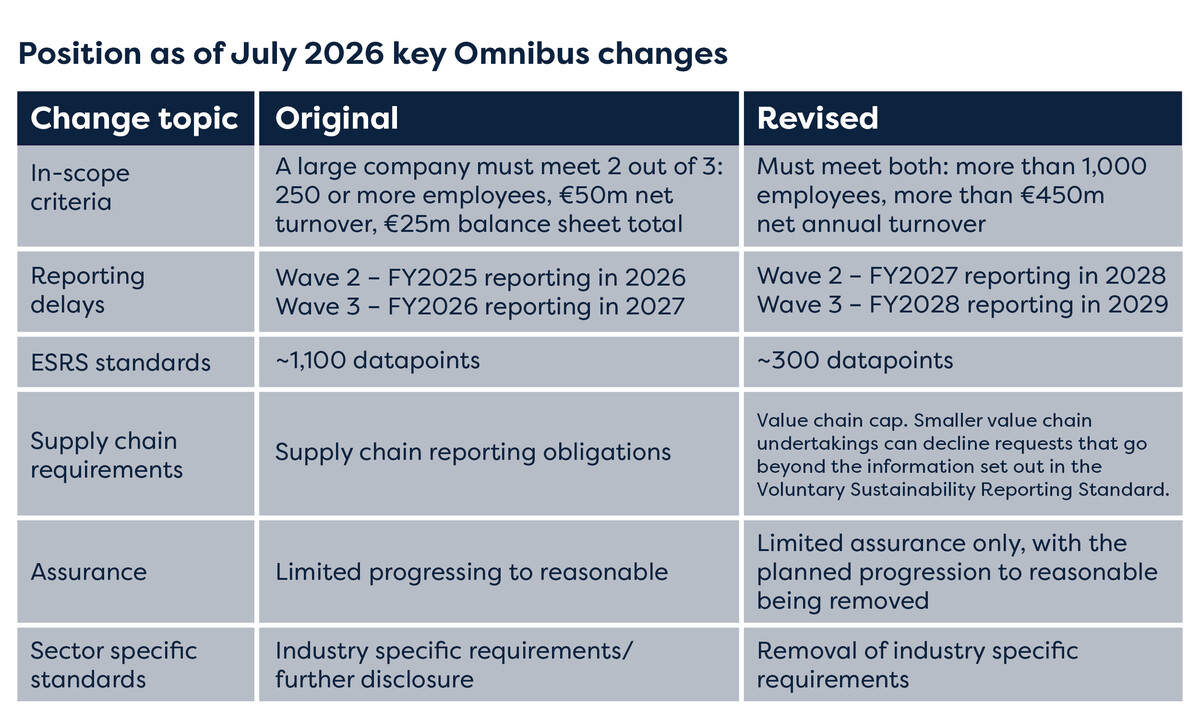
Compared with the original CSRD package, the Omnibus represents a significant simplification. While CSRD remains a major reporting requirement, the Omnibus is targeted towards larger companies that are more likely to have significant impacts on people and the environment. Businesses should not assume they are out of scope without checking the latest thresholds and how they apply to their group structure, EU presence and reporting timelines.
Are you in scope for the revised Omnibus CSRD?
Under the revised Omnibus CSRD the initial focus is on:
- EU companies with more than 1,000 employees and significant turnover thresholds, as well as certain non-EU groups with substantial EU activity and an EU subsidiary or branch.
Non-EU groups should assess whether they exceed the revised EU turnover threshold and have a qualifying EU subsidiary or branch.
UK-headquartered and other international groups may still need to assess whether their EU footprint brings them into scope.
Even companies that are not directly in scope may still feel the effects of CSRD. Larger customers, lenders or investors may request sustainability information from suppliers as part of their own reporting, although the Omnibus is expected to place clearer limits on the level of information that can be requested from smaller value chain companies.
How to prepare for initial CSRD reporting
- Confirm whether you are in scope: Review employee numbers, turnover, balance sheet totals, group structure and EU presence against the latest thresholds.
- Map your reporting timeline: Identify the first financial year you may need to report on and work backwards to build a realistic preparation plan.
- Start with double materiality: Understand which sustainability topics are most relevant to your business, stakeholders and value chain.
- Assess data availability: Identify which data points you already collect, where gaps exist, who owns the data and whether the information is ready for the assurance process.
- Strengthen governance: Put clear roles, responsibilities, controls and sign-off processes in place so reporting is reliable and repeatable.
- Engage early with stakeholders: Involve finance, sustainability, risk, legal, procurement, HR and operational teams from the start to avoid last-minute data challenges.
- Think beyond compliance: Use CSRD preparation to improve decision-making, manage sustainability risks and demonstrate credibility to customers, investors and regulators.
Why should you prepare for CSRD reporting now?
Although the Omnibus changes may give some businesses more time, or remove them from direct scope, preparation remains valuable. Sustainability data is increasingly being requested by various external stakeholders. Therefore, companies that start early are better placed to respond confidently, reduce reporting pressure and turn compliance into a stronger understanding of business performance and risk.
CSRD should not only be seen as a reporting exercise, but as an opportunity to gather more accurate data, build stronger governance and develop a clearer sustainability strategy. The sooner organisations understand their position, the easier it will be to prepare in a practical, proportionate and commercially useful way.
Do you have questions about the CSRD?
Speak with us at BIP.Verco. We can help you understand if you are in scope (either directly or as part of a supply-chain), what you can be doing to prepare for reporting and how you can disclose a CSRD compliant and assurance-ready sustainability report.
And if you're looking to take the next steps with your reporting, browse our ESG data and reporting service. We support your alignment to standards such as SBTi, GRESB, SECR, ESOS, SFDR, EU Taxonomy, CSRD, and IFRS S1 and S2.