Effectively manage occupier data to build confidence in your Scope 3 reporting

In today’s shifting landscape, occupier data plays an important role in your net zero journey. Occupier-controlled spaces account for a large portion of Scope 3 emissions. Therefore, by increasing the accuracy of your occupier data, you also increase how effectively you can manage your Scope 3 reporting and disclosures.
In this article, we explore why occupier data should be on your radar this year and suggest practical ways to increase your data confidence.
Having confidence in your occupier data is vital
Over the last decade, the focus has been on simply obtaining occupier data. There’s now a need for this data to provide a strong foundation for strategic decisions.
To make effective decisions in real estate, it’s important to ensure they are underpinned by quality data. This involves rigorous validation processes and standardised reporting methodologies that are comparable across portfolios.
If you invest in strengthening this foundation early on, you will be better positioned to navigate the rising regulatory and strategic expectations being placed on occupier data.
Reporting standards now require auditable Scope 3 data
The Scope 3 reporting landscape is seeing a rapid transition. Regulations and standards such as the Corporate Sustainability Reporting Directive (CSRD) and the International Sustainability Standards Board (ISSB) now require you to report on your material Scope 3 emissions, explain your methodologies and data quality, and treat sustainability reporting with the same level of rigour as financial reporting. As a result, auditability is now emerging as a new requirement for Scope 3 reporting.
Accurate occupier data affects financial and operational performance
Alongside increasing regulation, there are other financial and operational drivers for accurate occupier data:
implementation of data-driven smart leases,
retrofit plans to avoid risk stranding, and
progression towards net zero targets.
How to increase confidence in your occupier data
Reducing the estimations, assumptions and incomparable methodologies that are currently seen across occupier data are some of the key steps towards increasing data confidence. We recommend that you take a dual approach and use a data quality framework tool alongside an occupier engagement programme.
Use the Partnership for Carbon Accounting Financials (PCAF) data quality framework tool
The Partnership for Carbon Accounting Financials (PCAF) data quality framework is part of the PCAF Standard. Originally developed to standardise carbon accounting for financial institutions, it provides a useful reference point against which you can assess the reliability of your occupier data. PCAF uses a five-tier data quality score, with Level 1 being the most reliable and accurate, and Level 5 being the least reliable.
Level 1:Actual building consumption from metered data with supplier-specific emission factors applied
Level 2: Actual building consumption from metered data with average emission factors applied (DEFRA)
Level 3: Estimated building energy consumption based on floor area and building energy labels, with average emission factors applied
Level 4: Estimated building energy consumption based on floor area and building type/location specific area factors, with average emission factors applied
Level 5:Estimated building energy consumption based on building type and the number of buildings, with average emission factors applied
By implementing PCAF rankings across your occupier data, you can not only assess its reliability for decision making, but also highlight gaps across your portfolio that you can target.
Develop your occupier engagement programme
Occupiers contribute a large percentage of a building’s total emissions, so understanding their data is vital in reducing the owner-occupier divide, assessing the overall energy performance of your assets and analysing what savings are possible.
A portfolio’s Level 1 data is often challenging to manage as part of Scope 3. Occupier data can be hard to obtain, as you move through the complexities of GDPR and lease agreements.
However, we are seeing tenants shift from passive occupiers into interested parties. They often have their own ESG targets and a growing interest in understanding the performance of the asset they operate in. Tenants, especially commercial occupiers, are keen for more insight into their performance. Make the most of this opportunity to engage with them and encourage them to get involved.
For examples of the impact of effective occupier engagement programmes, read our case studies with Landsec and Cadogan. Our experts helped these two organisations connect with their tenants, improve and visualise the actual data for their occupied spaces, and reduce their energy intensity as a result.
Move from estimations to targeted feedback loops and automated data collection
Occupier data is often gathered manually, which may not be feasible on a very large scale. This time intensive requirement often results in a need for gap filling through various estimations and assumptions, which reduces the data quality of your reporting and leads to inconsistencies between portfolios. Using estimation methodologies also opens you up to the riskier knock-on impacts of other poor-quality data, such as missing floor areas and fragmented occupancy data.
Improving occupier data quality is not a linear process, so generating feedback loops can help. These progress your portfolio towards better coverage and increase the overall quality of your data. We recommend a phased approach, as this allows you to target your most material buildings, engage with property managers and occupiers, and make use of the automated data collection services available.
Determine your current level of occupier data accuracy, and your next steps
Use the graphic below to assess your current processes and find out how you can improve your occupier data accuracy.
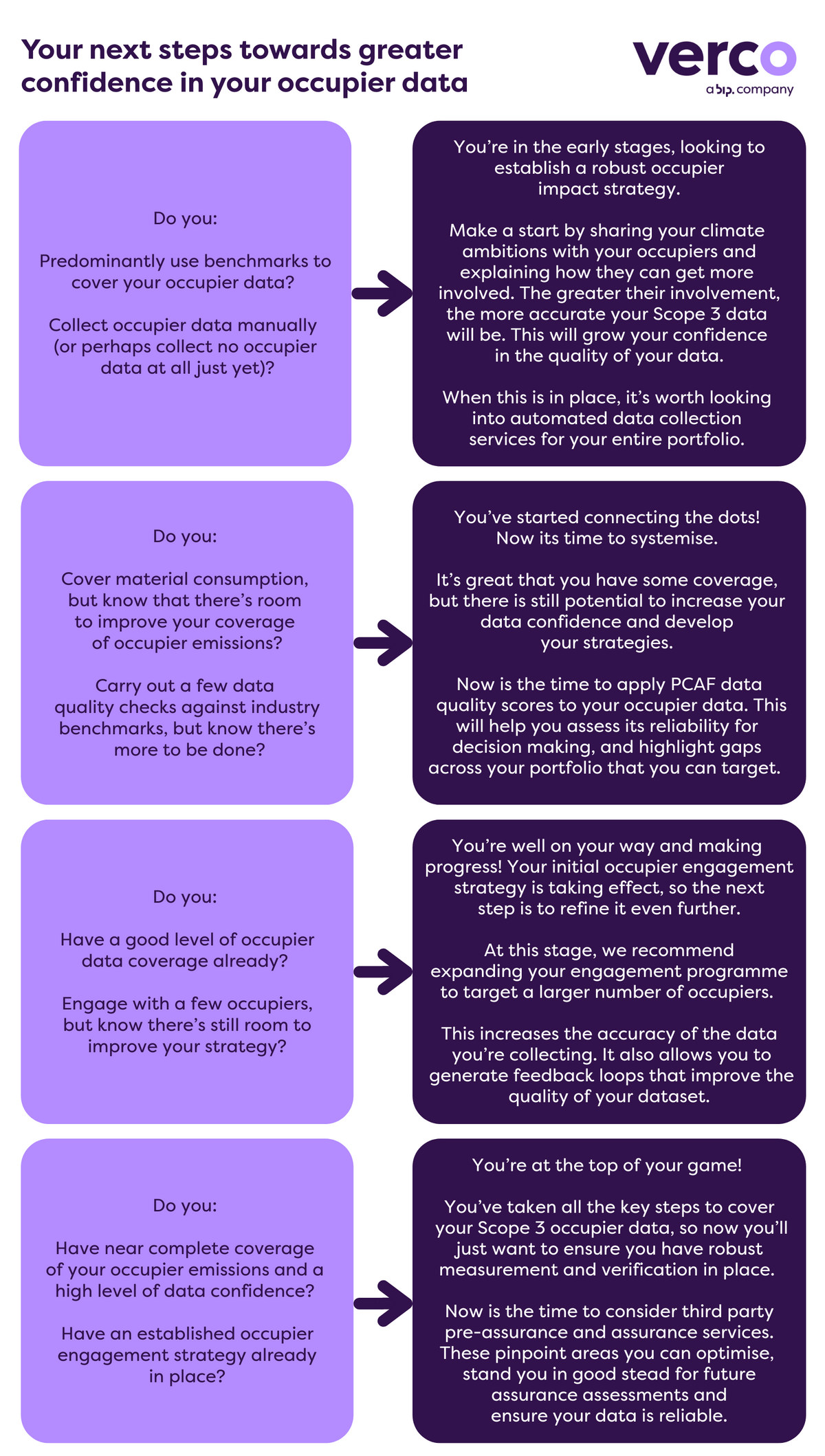
Build towards a reliable Scope 3 dataset with higher PCAF rankings
In summary, here are our top tips for increasing the quality of your occupier data, which will positively impact your Scope 3 reporting:
Target an occupier engagement programme towards buildings with low PCAF data quality. This will lift your portfolio’s overall data quality and increase your actual data coverage.
Reduce data gaps by actively engaging with property managers and tenants. You can do this though interactive tools such as dashboards and regular check-ins.
Actively reduce assumptions across your portfolio by confirming your most material meters with occupiers and property managers.
Ensure your occupier data is audit ready, with a systematic and comprehensive methodology in place as well as a long-term plan for improved, accurate data that is ready for decision making support.
Remember, our experts are always on hand to give advice on the complexities of occupier engagement
We are experienced in helping set targets for Scope 3 reductions and advising on the best methods. We understand how complex the dynamics between asset owners and occupiers can be and we have considerable experience of delivering bespoke reporting or data visualisations to assist the engagement process.
Browse our service document for an overview of how we can help, or contact us for a consultation.