This year's biggest challenges for real estate professionals (and how to overcome them)
Each year, in our Climate Action in Real Estate survey, we ask our network of real estate professionals what they consider to be the greatest barriers to climate action. We do this so we can compare the results to those of previous years, tracking how the sector is changing and learning how best to support our clients.
The graphic below shows the barriers that have been voted the most challenging for the year ahead over the last three years:
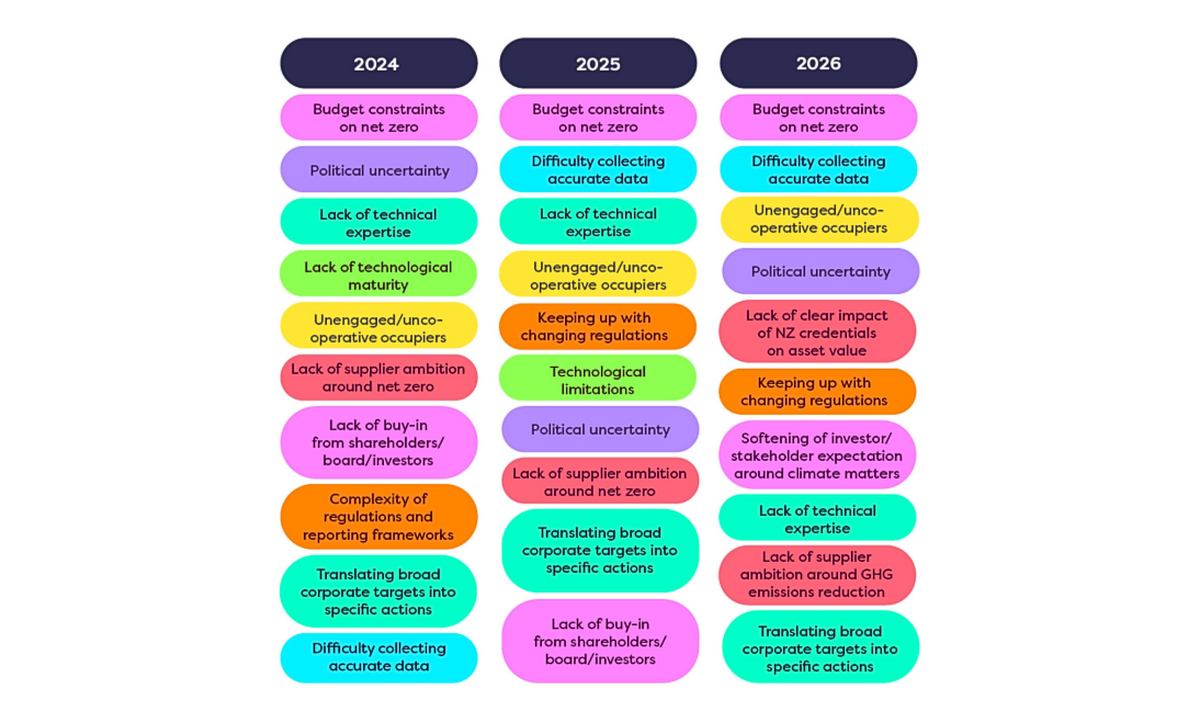
It is interesting to see how the events of each year impact the barrier’s position in the list. For example, after a year of publicised ‘backlash’ around ESG and net zero, it is unsurprising to see political uncertainty rising up as a key challenge for 2026. However, there’s hope: the results of our survey also show that the geopolitical landscape has not hugely impacted the long-term views and expectations of investors. These have, on the whole, stayed the same or increased. While the baseline expectations for ESG performance and disclosure are stable, a slight uptick in pressure suggests investors are tightening scrutiny without shifting priorities.
You can find insights about other trends in the full report, available here.
In the rest of this article, we’ll explore the top three challenges for 2026, providing expert advice on how to tackle them throughout the year.
1) Budget constraints limit possibilities
Though the real estate sector remains generally optimistic about climate action, financial limitations can result in projects being compromised or delayed.
When allocating budget, real estate professionals must weigh decarbonisation initiatives against other essential expenditures and potential market upside. Since carbon reduction measures that change asset characteristics often have high upfront costs and long payback times through energy costs alone, making a solid business case can be tricky.
One way to navigate this challenge is to ensure you are optimising your buildings - that is, operating as designed and closing the performance gap. It's likely you're already collecting lots of data that you can turn into immediate savings. All you need to do is use it to identify easy optimisation opportunities. Then you can:
extend the life and reliability of your assets, meaning you’ll save on repairs;
plan ahead and avoid costly, last-minute replacements and/or high-carbon lock-in;
prove, with data, why budget should be allocated to decarbonisation initiatives to achieve long term commitments.
Find out more about building optimisation
2) Collecting accurate data is difficult
When it comes to climate action, unlocking progress is largely influenced by the quality, availability, and auditability of data. According to our report, ‘2026 looks set to be a year of consolidation, collaboration and risk management,’ and ‘those with audit-ready data will be best placed to access capital.’ However, with carbon reduction data being tracked in many ways and across many different platforms, lots of real estate professionals find it challenging to collect and review it all with confidence.
Our advice for tackling this challenge is to focus on bringing your data together, so you can look at patterns, scenarios and forecasts, and then consider third party pre-assurance or assurance to ensure your reporting is accurate.
Now that data platforms are advancing, we recommend using an energy management platform or software, like MyVerco, to bring data from all of your carbon reduction projects together. Platforms like these connect to the systems you already use, remove the headaches of spreadsheet filing and version control, and present your data in helpful graphs and charts that allow you to view progress in real time. Getting everything you need in one place makes your reporting, collaboration, and forecasting much easier.
Then, once you have a good overview of your data, improve shareholder confidence in your reporting and disclosures with a pre-assurance check and/or assurance assessment. Pre-assurance mirrors aspects of the assurance process, acting as a kind of ‘mock test’, but with greater opportunity to consider solutions to issues identified. Companies use it to test current processes and how close they are to being ready for formal assurance. Then, when they have made the changes highlighted by the pre-assurance report, they move on to formal assurance, which provides an independent conclusion and ensures that certain data (for example, GHG emission data) is free from material misstatement.
Find out more about pre-assurance
3) Disengaged occupiers hinder data collection
Collaboration between owners and occupiers is essential for collecting the most representative data and achieving whole-building carbon and resilience goals. The vast majority of real estate portfolios are heavily weighted towards occupiers for operational emissions, while capex and long term decarbonisation goals sit with the owner. With accurate tenant data, therefore, it’s easier to identify assets that are likely to be a problem on the road to your targets.
However, it’s often a challenge to bring occupiers on board with a building’s climate action strategy due to difficulties in data collection, continued engagement, and data privacy. This is especially true for landlords with FRI leases, where occupiers control their own energy use.
Getting occupiers on board with asset management goals requires time, strong data, and clear goals. This year, unengaged / uncooperative occupiers were identified in the top three challenges for the year ahead and 68% of survey respondents placed stakeholder engagement among their top priorities for 2026, so here’s what we’d advise:
Unlocking quick wins through site visits and opportunity reports. These reveal low- or no-cost measures that can immediately improve efficiency and reduce carbon.
Sharing plans, reports and data visualisations with the occupiers, allowing them to see the impact of their engagement, the benefits this delivered for them and how this will help them meets their goals.
Facilitating collaboration by connecting clients, occupiers, and other stakeholders, and aligning them on climate objectives.
Find out more about our occupier services
Stay informed about the real estate sector's climate journey
You can download and browse the full report, Climate Action in Real Estate: Market Outlook 2026, by clicking the link below.
Look out for more articles in this series
This article is part of a series exploring the valuable data we collected in the report, so keep an eye on our website and social media for the latest updates. Here are the other articles in the series:
Finally, please get in touch if you'd like tailored advice on your next steps and how we can help you this year.