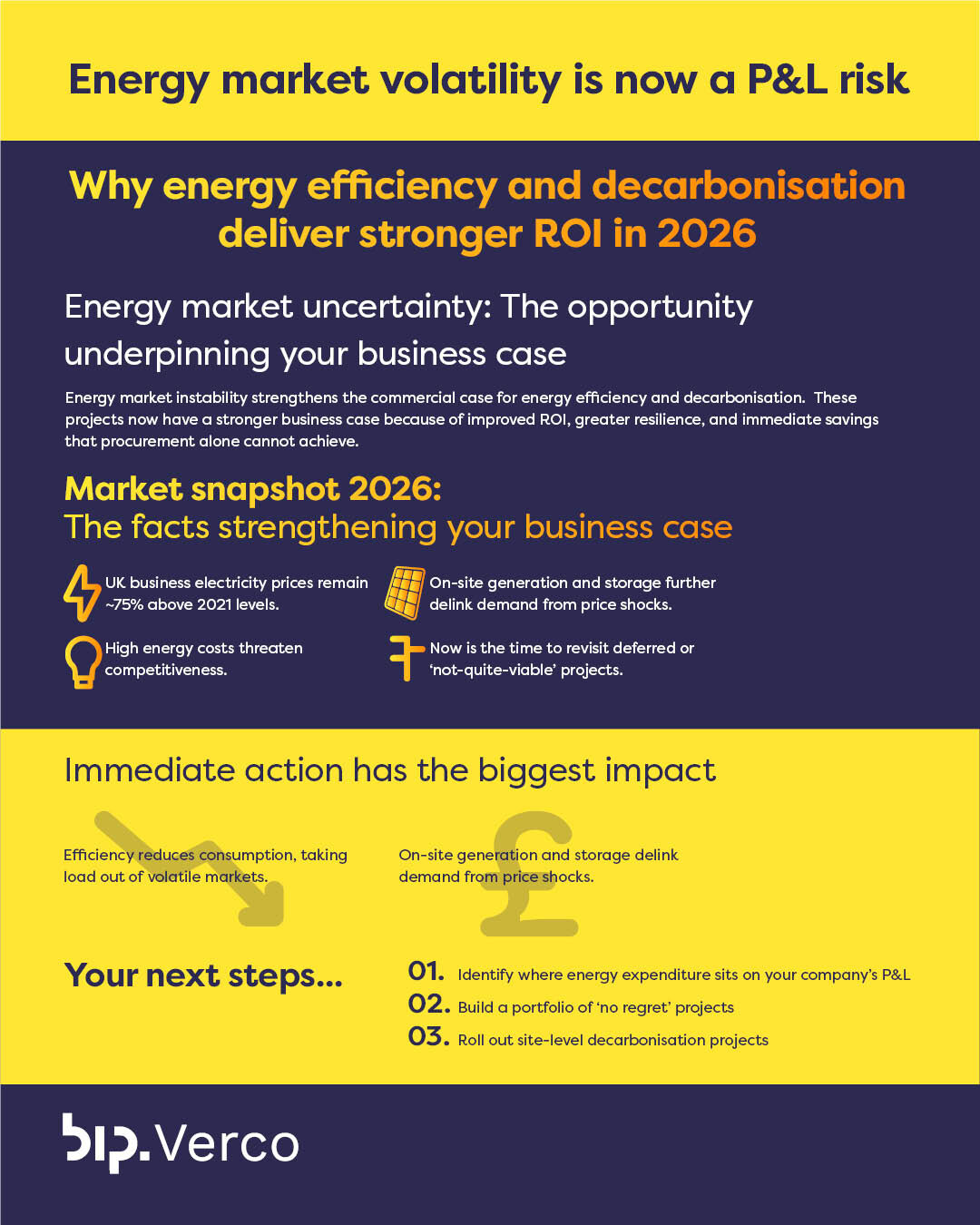
Energy market volatility is now a P&L risk: Why energy efficiency and decarbonisation deliver stronger ROI in 2026

Energy market volatility has turned energy from a controllable cost into a material P&L risk. With prices still well above pre‑2021 levels and volatility persisting into 2026, energy efficiency and decarbonisation projects now deliver stronger ROI than ever. This article sets out why doing nothing is the riskiest option and how cutting demand is the most reliable hedge.
If you do nothing else after reading this article, identify where energy expenditure sits on your company’s P&L and calculate how your current wish‑list of energy efficiency and decarbonisation projects could reduce that cost.
With energy market uncertainty rising, energy efficiency and decarbonisation projects now have a stronger business case than at any point in the past year. Projects that previously struggled to secure approval may now be financially compelling. There is improved ROI and a heightened sensitivity to energy price volatility among finance leaders.
Energy Market Uncertainty: The Opportunity Underpinning Your Business Case
For sustainability and energy professionals, periods of instability often sharpen the commercial case for action. When risk increases, so does the opportunity to secure investment in projects that reduce consumption, cut carbon and improve resilience.
If you work in sustainability or energy management, today’s energy market uncertainty is a powerful lever. The commercial rationale is simple: every quarter that passes without action leaves rising, compounding savings on the table and exposes more of your cost base to volatile markets.
In volatile energy markets, the cheapest and least risky MWh is the one you never have to buy and that avoided cost is increasing.
If you need a compelling narrative for your CFO, this article is a good place to start. It brings together current market dynamics, financial logic, and the practical steps that strengthen the case for energy efficiency and decarbonisation.
Market Snapshot 2026: The Facts Strengthening Your Business Case
Heading into Spring 2026, energy has become a strategic P&L risk that demands board-level attention. It reinforces a long‑held truth amongst sustainability professionals: when a sustainability strategy is fully integrated into business strategy it unlocks real commercial benefits.
Across UK and EU markets there are many examples of the volatility companies are exposed to and the potential impact on their competiveness:
UK business electricity prices remain ~75% above early 2021 levels (1).
Dutch TTF gas surged 74% in a single month in March 2026 (2).
In February 2026, Energy UK and the CBI jointly warned that persistently high energy costs threaten UK competitiveness (3).
The BNP Paribas 2026 Corporate Risk Management Outlook highlighted how rising energy costs could restrict EU growth (4).
The European Securities and Markets Authority warned that ongoing energy price swings could trigger disorderly market corrections (5).5 Across Europe, the message is consistent: energy is no longer just a cost line item; it is a matter of operational sovereignty and supply chain resilience. In an era of geopolitical polycrisis, the cheapest MWh is the one you don't use, but the most secure MWh is the one you control. In this landscape, decarbonisation and efficiency are the ultimate hedges against external shocks
Why Immediate Action Has the Biggest Impact
For CFOs, the financial logic is clear: The ROI of energy reduction projects increases as energy prices rise. According to the International Energy Agency, firms rank efficiency as their top strategy to offset price volatility, followed by on‑site renewables (6).
Even with a proactive procurement strategy, hedging can only smooth the price you pay not the volume you consume. Efficiency is the only lever that permanently reduces exposure.
Efficiency reduces consumption, taking load out of volatile markets.
On‑site generation and storage further delink demand from price shocks.
Many organisations have a backlog of “not-quite-viable” efficiency or decarbonisation projects that stalled due to slower ROI or limited engagement. The economics have changed. Those projects now carry significantly improved business value.
Now is the time to revisit them and be ready to demonstrate how acting today can materially impact both sustainability outcomes and the company’s P&L.
What You Can Do Now: Building Your Business Case and Accelerating Delivery
We cannot predict future energy prices but the consensus is clear: volatility and uncertainty will persist.
Energy efficiency and process optimisation projects no longer sit solely in the sustainability agenda. With energy costs rising toward the top of finance P&Ls, they have become strategic levers for financial performance.
If you have projects that couldn’t get approval last year due to ROI or engagement challenges, this is your moment to reassess and reposition them with a financial-first narrative.
Your Next Steps
1. Identify where energy sits on your P&L
Understand how exposed your organisation is and model how efficiency and decarbonisation projects reduce that cost both today and under higher‑volatility scenarios.
Refresh your proposals with updated ROI, IRR and payback calculations that reflect today’s market. Highlight the savings already missed through inaction.
2. Build a portfolio of “no‑regret” projects
Target early wins that deliver 10–15% site energy reduction in year one, focusing on:
Controls optimisation
Heat recovery
Motor systems
Building management system upgrades
For example, this project that BIP.Verco completed for a major Private Equity portfolio to model potential the savings and CAPEX requirements of a range of energy projects.
3. Roll out site-level decarbonisation roadmaps
Use digital twins and measurement-and-verification baselines to plan three‑to‑five‑year investments in:
Process heat electrification
Heat pumps
Demand flexibility
On‑site solar PV and storage
For example, this project Bip.Verco completed for a major global aerospace leader to develop a decarbonisation strategy and optimal investment plan.
4. Deliver on the plans
Identifying the ROI is only 10% of the battle; the other 90% is execution. Site managers are already stretched thin, and execution risk is why many business cases fail. To move from a spreadsheet to a delivered project, you need implementation expertise. We provide the boots on the ground and trusted local delivery partners who speak the language of both the CFO (CapEx, IRR) and the Site Manager (uptime, safety, operational continuity). This ensures delivery risks are mitigated and promised ROIs are actually realised.
You cannot manage what you cannot continuously measure. Delivering these roadmaps requires moving beyond static spreadsheets. By leveraging digital twins, BIP Group’s wider AI capabilities, and continuous tracking platforms like MyVerco, you create a dynamic feedback loop. This ensures that the energy savings promised to the board in year one are actually tracked, delivered, and optimized in year three across investments.
Need Help Getting Started?
If you’re unsure where to begin, our team has developed a range of resources to help you identify the right projects and prioritise next steps. The guides and case studies below show the types of interventions that deliver the strongest savings.
Rapid costed decarbonisation: Costed insights identify the wins, but layering on our implementation expertise gives you confidence on how, where and when to execute. This accelerates the business case for site decarbonisation.
Rapid costed decarbonisation for real estate
Rapid costed decarbonisation for manufacturers
Building optimisation: Reducing consumption, extending asset life and enabling low‑cost decarbonisation.
Heat decarbonisation (manufacturing & life sciences): Essential for reducing Scope 1 and 2 emissions; heat often accounts for >50% of site emissions.
Our experts are happy to jump on a call to help refine your business case, quantify savings, and, crucially, provide the boots-on-the-ground implementation expertise to get your projects delivered.