CHP optimisation for manufacturing: reduce carbon and costs and achieve tax savings

In today’s market, manufacturers can achieve significant tax savings and reduce energy costs via the CHPQA scheme and Combined Heat and Power (CHP) optimisation.
In this article, specialists Justin Okpe and Matt Dickinson explore the scheme, the benefits of CHP units and how market leaders are optimising heat utilisation.
What is the CHPQA scheme?
The CHPQA scheme is the UK’s framework for assessing CHP efficiency. It determines eligibility for incentives such as Climate Change Levy (CCL) tax relief, partly driven by the Quality Index (QI) score – this evaluates the overall energy efficiency and delivery of primary savings.
Are manufacturers still choosing CHP units?
In modern installations, CHP units are typically driven by high efficiency reciprocating gas engines. These are favoured for their strong heat to power ratio performance and operational flexibility, making them well suited to industrial energy demands. The current gas:electricity price ratio (‘spark gap’) and high efficiency engines lead to electricity production at a rate lower than grid electricity.
What trends are we seeing in CHP performance?
Across the range of installations we reviewed for CHPQA submissions, engines were generally performing well from a power generation perspective, with electrical efficiencies typically in the 37–44% range. However, heat utilisation was low. In all cases, heat was being rejected to atmosphere at certain times. Overall heat used averaged less than 50% of CHP generated heat.
Other trends we noticed were:
Most installations used reciprocating engines with high electrical efficiencies. Very few schemes utilised Low Temperature Hot Water (LTHW) generated at the engine cooling jackets. LTHW heat was often rejected to atmosphere.
All schemes combined CHP with additional boilers for redundancy and peak heat load provision.
The use of accumulators or other forms of thermal storage were limited.
Nearly all of the installations were electrically led and operated at fixed electrical output with no modulation or dynamic controls.
What are the key opportunities for continuous CHP improvement?
Many of the CHP systems we reviewed had several years of operation left under existing contracts. Operating conditions and load profiles had changed from the initial installation, with further changes in production planned for future years.
As a result, there is frequently scope to modify the CHP operation. This achieves cost and/or carbon benefits with paybacks within the remaining lifetime of a CHP plant.
Improved modulation and control
Most CHP units are operating at a fixed output and are frequently limited to avoid export. Adding modulation to maximise output is a relatively simple way to increase utilisation and reduce import electricity costs.
However, in some cases, contract details are seen as an obstacle to implementing modulating controls. Many CHP contracts are based on simple uptime and output agreements, limiting the scope to modulate and optimise operation.
Heat utilisation
Overall, heat utilisation was very low. The two most common reasons for low heat utilisation were:
zero or very low use of heat outputted as LTHW (typically around 90°C); and
bypassing of waste heat boilers at times of low heat demand.
In cases like these, there are several ways in which heat utilisation can be improved, including:
Installing LTHW networks to deliver heat to lower temperature demand processes. With many processes operating at <90°C, there is scope to use LTHW and displace gas used in steam boilers. At the very least, LTHW can be deployed for hotwell heating.
Use of LTHW to drive absorption chillers.
Use of LTHW to raise further steam through vacuum boiler and vapor compression processes.
Modulation of the engine to operate as heat-led and improve overall system efficiencies.
Incorporation of thermal storage to store heat from periods of low demand and offset further steam production at times of peak demand.
Improving heat recovery can also significantly boost CHPQA scores, often pushing systems above the Quality Index threshold and unlocking additional CCL savings. These can be worth £10k–£20k per year, for schemes with an electrical generation capacity of between 1-2.5 MWe. Additional savings arise from avoidance of raising additional heat in gas boilers.
Case Study: the value of improving heat utilisation
One submission we made on behalf of a major food producer demonstrated the tangible value of improving heat utilisation. We helped them increase their LTHW utilisation from 13% to 29%. This uplift drove a significant improvement in CHPQA performance, bringing the Quality Index close to the qualifying threshold and unlocking additional CCL tax savings of approximately £19k per year.
The recovered heat can now be utilised to displace conventional gas demand, usually gas used in steam boilers. In this example, the saving equated to a further £216k per year in avoided energy costs (7.2 GWh/year at a 3p/kWh gas price). The charts below illustrate the operation before and after the changes:
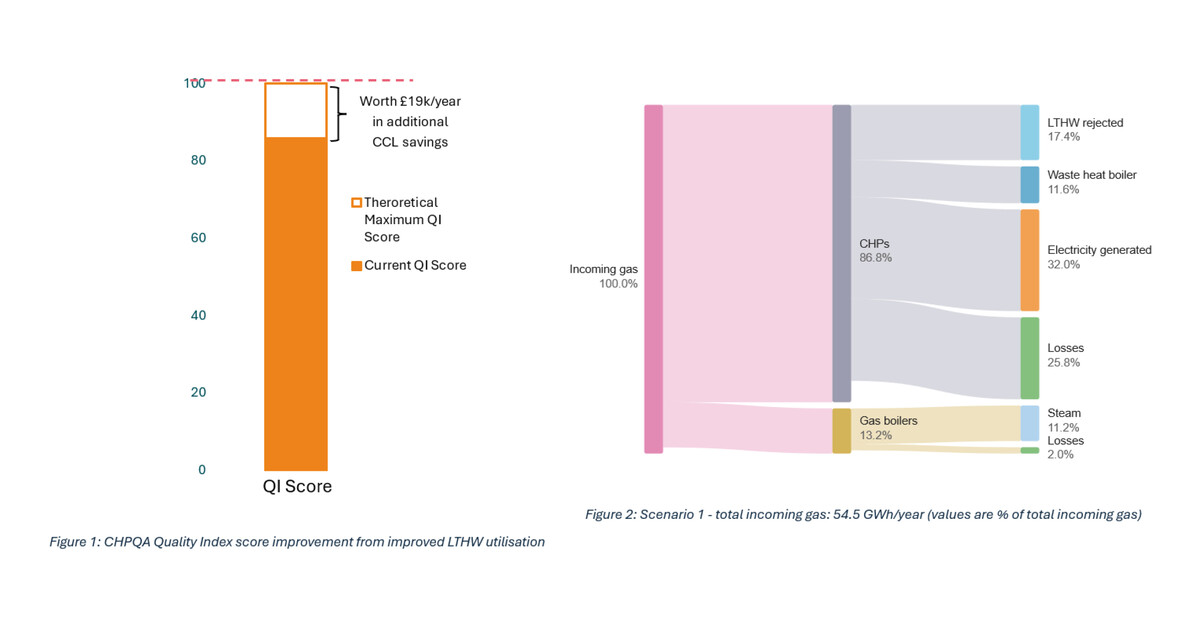
Alongside the financial gains, this optimisation delivered a meaningful carbon reduction benefit, lowering annual emissions by approximately 1,300 tCO₂e.
Cost of reserve
System resilience and redundancy are essential parts of any heat generation system.
Back up burners on waste heat boilers are standard practice, as are additional gas-fired steam boilers (for redundancy and to provide additional capacity).
Sometimes, we see back up capacity operating consistently at minimum fire. This results in a loss of overall efficiency. In these cases, costs and emissions can be reduced through modulation and better system integration through sequencing controls. Building in some inertia through heat storage and buffering can also be valuable.
Metering and monitoring
Reliable metering and system monitoring has benefits beyond enabling CHPQA scheme qualification. Good quality metering provides a clear picture of both electricity and heat demand profiles. This can be used for system optimisation. Further metering and monitoring of all system components (including back-up boilers) can enable more efficient system integration. Where data is available from the CHP control system, it is essential that the data is logged and trended to enable analysis and optimisation.
Beyond CHP
At current gas:electricity price ratios, there is a clear financial benefit to CHP over importing grid electricity and generating heat using gas fired boilers.
The CO2 balance is a very different equation. As the electricity grid decarbonises over time, the carbon benefit of CHP reduces. Even with 100% heat utilisation, the use of CHP engines is now more carbon intensive than grid electricity and gas fired boilers.
The chart below shows the net carbon impact of CHP over time, using historical and predicted grid emission factors. The chart assumes an electrical efficiency of 40% and 40% heat production. The two lines demonstrate the net carbon impact with 50% and 100% CHP heat utilisation. This is compared to a reference condition of importing grid electricity and raising heat in gas-fired boilers (UK as a reference).
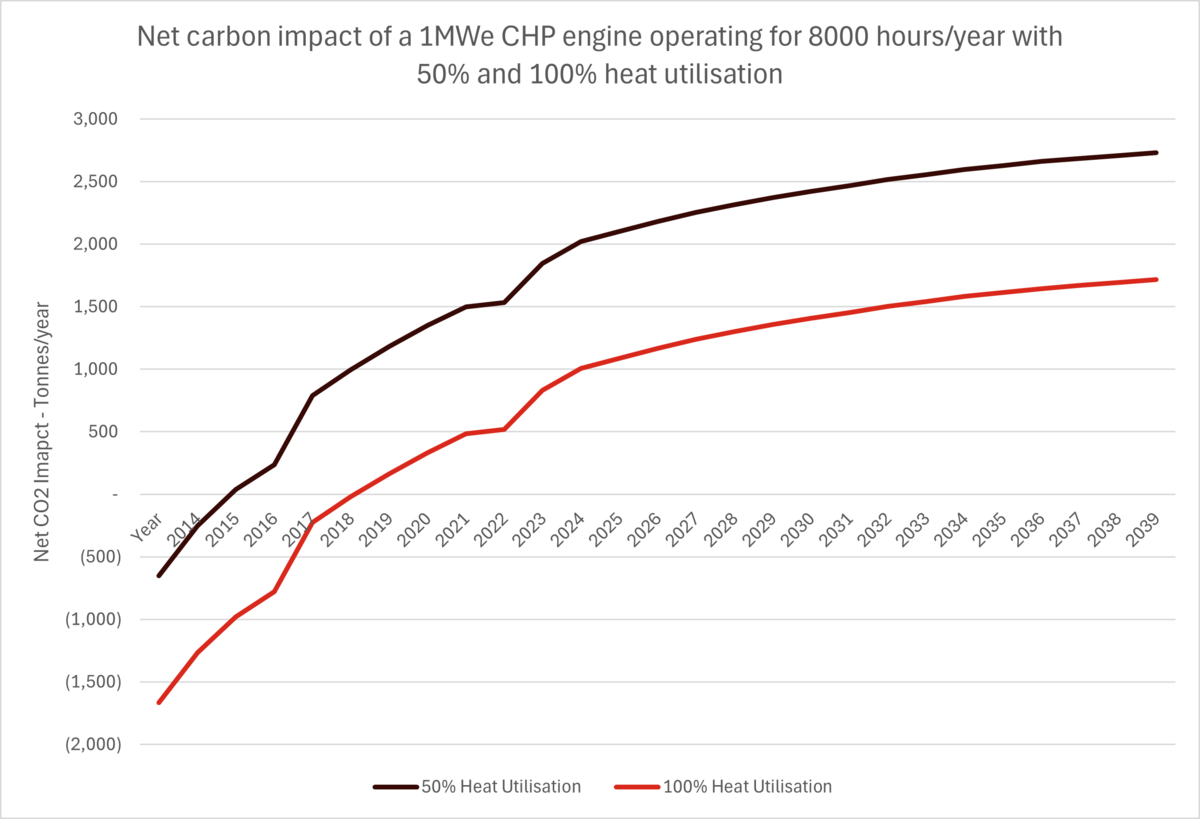
The chart shows that the carbon impact of running CHP engines will increase over the lifetime of many CHP installations. Natural gas-fired CHP units are now a carbon cost to businesses and are not compatible with medium- to long-term heat decarbonisation.
With recent moves to break the market links between gas and electricity prices, CHP is also at risk of becoming a net revenue cost instead of a benefit.
Like-for-like replacement of CHP engines at end of life will not help sites achieve decarbonisation targets. Now is the time to start assessing viable alternatives and working towards future heat and power provision. For example, technologies such as heat pumps are going through rapid development, with an increasing range of options becoming available. Even without committing to a single technology for transition, there are moves that can be made to enable sites to transition in the future.
Enabling works can include:
assessment of future site power demands without CHP, including electrical heat alternatives such as heat pumps;
improving metering to build detailed heat and power demand profiles;
starting application processes and discussions with network operators on current and future capacity upgrades;
‘de-steaming’ heat demands and planning LTHW heat networks;
identifying heat recovery opportunities to reduce heating demands or provide a heat source for future heat pump installations; and
pre-qualification CHPQA assessments.
How can BIP.Verco help with CHP?
Our expert team has extensive experience in CHP operation and optimisation in manufacturing.
Understanding options for heat decarbonisation at your site
We have prepared a series of guides which can be found here. If you are interested in exploring low carbon heat solutions for your site and alternatives to CHP, please see our Low Carbon Heat Blueprint service here.
Optimising your CHP
We assess current CHP operational efficiency and identify means to optimise heat utilisation, including heat storage and LTHW use.
We model different control and usage profiles, including modulation to optimise power and/or heat utilisation.
We specify works needed on site to implement any changes and support to procure the works.
We undertake full turnkey submission of CHPQA applications on behalf of client CHP schemes.
Find out more about our CHP optimisation service
We would welcome a discussion to see if we can help you. Please use the link below to book a call.