How can you embed CSRD effectively across your organisation? Four lessons from the first implementation year
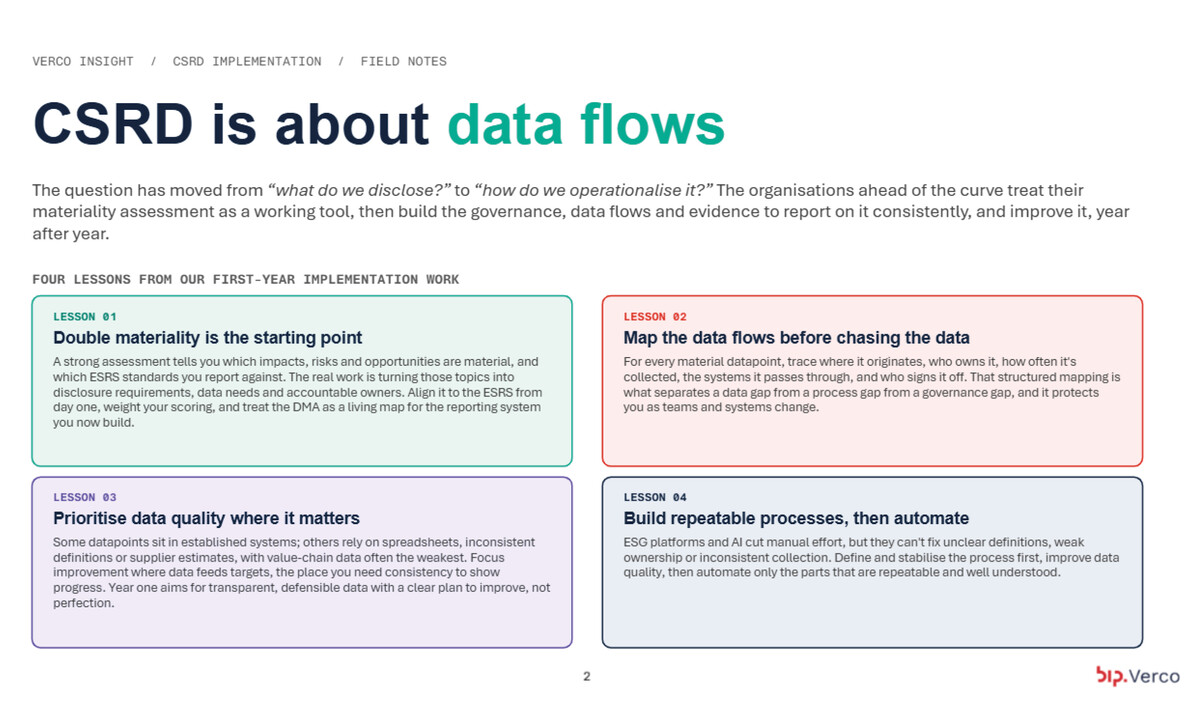
With the finalised ESRS adopted and the first wave of CSRD reports now published, the question has shifted from "what do we disclose?" to "how do we operationalise it?"
Most stakeholders in finance and ESG understand the regulation at a high level. However, fewer know how to embed it into how their organisation collects, manages, and reports ESG data.
For an introduction to CSRD and the key requirements organisations need to be aware of, read our article here.
The organisations making real progress treat their materiality assessment as a working tool, not a finished deliverable. They use it to identify their material impacts, risks and opportunities. Then they build the governance, data flows and evidence to report on it consistently, year after year, with continual improvement.
In this article we highlight four key lessons from the first implementation year to help organisations move from understanding what CSRD requires to robust and effective delivery.
Lesson 1: Double Materiality is the starting point, not the output
A Double Materiality Assessment (DMA) looks at two things:
- the impacts an organisation has on people and the environment; and
- the sustainability risks and opportunities that affect its own financial position.
It identifies which impacts, risks and opportunities (termed ‘IROs’) are material, and so which ESRS standards you report against.
It's tempting to treat the DMA as a self-contained project where you run the workshops, outline which topics are material and relevant to your organisation, validate the results, and insert them as-is into reporting. In practice, the DMA is where implementation begins. It’s essential to align the DMA structure with the ESRS standards early on, to avoid remapping topics later.
The harder and more valuable work is what follows: turning material topics into disclosure requirements, data needs, accountable owners, evidence, and reporting timelines. This is where CSRD's complexity surfaces. A topic may sit conceptually with sustainability, but the underlying data is usually scattered across procurement, finance, HR, operations, legal and local business units. Without clear ownership, progress stalls on basic questions, such as:
- Who approves the methodology?
- Who checks and signs off the assumptions?
- Who improves data quality over time?
- Which datapoints should you improve upon first?
Two things separate a DMA that works from one that gathers dust.
First, treat it as a living process rather than a compliance exercise. Where an enterprise risk management framework exists, align the DMA with it so the language, scoring and governance are consistent across the business. If one does not yet exist, establish a clear and repeatable methodology for assessing, documenting and governing impacts, risks and opportunities detailed in the standards.
Second, weight your scoring. Not every impact, risk or opportunity carries the same significance. Validate the results with internal and external stakeholders. Treat the DMA as the map for the reporting system you now will build.
Lesson 2: Map the data flows before chasing the data
Once you know which topics are material, understand how that data already moves through the business before you start collecting it.
For each material datapoint, trace the full path:
- where it originates;
- who owns it;
- who collects it and how often;
- the systems it passes through;
- who reviews and signs it off;
- the evidence behind it; and
- the disclosure (or disclosures) it ultimately feeds.
Some of this is straightforward. Electricity consumption, for example, may already be captured for carbon accounting and has a relatively clear data collection and reporting process. Other aspects, like waste, supplier data or value-chain metrics, can be manual, inconsistent, or reliant on third parties.
Structured data flow mapping is what separates a data gap from a process gap from a governance gap. You might have the data but no owner, an owner but no consistent methodology, a methodology but no evidence trail, or a process that works once but is too manual to repeat every year. It often varies by region too, with different systems and informal governance in play.
Doing this properly in year one can be tedious, but it lays a strong foundation for the following years. It also protects you as teams change and systems evolve, which is when undocumented processes quietly break.
Once the flows are clear, you can standardise them and, where it makes sense, automate them.
Lesson 3: Prioritise data quality where it matters most
CSRD asks you to know where your most important limitations sit, particularly across the material ESRS topics your DMA has identified.
For most organisations, year one reveals a mixed picture. Some datapoints are backed by established systems and controls. Others rely on manual spreadsheets, inconsistent definitions or supplier estimates. Value-chain data is often the weakest, since it depends on suppliers still building their own reporting.
A practical first-year approach is to assess quality across material datapoints and focus improvement where it counts. Ask:
- Is the data actual or estimated?
- Are methodologies consistent?
- Are assumptions documented?
- Can the same approach be repeated next year?
This matters most where data feeds targets, and where you need consistency to show credible progress. The aim in year one is not perfect data but transparent, defensible data with a clear plan for improvement.
Lesson 4: Build repeatable processes before relying on automation
Technology has a genuine role here. Many organisations are reviewing ESG platforms or exploring how AI can support reporting. These tools cut manual effort and improve consistency, but they can't fix unclear definitions, weak ownership or inconsistent data collection.
Define the process before you look to automate it. Ask:
- Which datapoints are material?
- Which systems hold the data?
- Who owns it?
- What checks are done?
- What evidence is kept?
- How are estimates flagged?
- How are changes to methodology or systems managed without losing year-on-year comparability?
A phased approach works best: map and stabilise the data flows, improve data quality, then automate the parts that are repeatable and well understood.
CSRD readiness is built before reporting season
Readiness is built long before reporting season starts. The organisations ahead of the curve run CSRD workstreams as an ongoing programme with:
- clear data ownership;
- standardised methodologies;
- evidence that stands up to assurance; and
- a realistic plan for closing gaps surfaced by the DMA.
The most common assurance problems in the first wave were avoidable: missing evidence behind reported figures, and data systems that changed between the base year and the reporting year without a clear trail. Both are far easier to prevent than to fix retrospectively.
None of it has to happen at once. But it does have to start with an honest look at your data flows and their quality. Get that foundation right, and everything downstream (assurance included) gets easier.
BIP.Verco can help you with CSRD
We can help you turn these lessons into practice, by:
- building a materiality assessment that works as a living tool;
- mapping your data flows;
- strengthening data quality where it matters most; and/or
- establishing repeatable processes that stand up to assurance year after year.
And if you're looking to take the next steps with your reporting, browse our ESG reporting and disclosure services. We support your alignment to standards such as SBTi, GRESB, SECR, ESOS, SFDR, EU Taxonomy, CSRD, and IFRS S1 and S2.
Prefer to see this content in video form?
Watch Allegra present the four key lessons here: