NZCBS and NABERS: key takeaways for UK offices from the BCO National Conference in Edinburgh

At this year’s British Council for Offices (BCO) National Conference, two of the key climate mitigation initiatives for the UK offices sector took centre stage: NABERS UK and the Net Zero Carbon Buildings Standard (NZCBS).
Held 18–19 June in Edinburgh, the conference brought together around 1,000 delegates from across the UK offices sector. Sustainability has long been a priority for the British Council for Offices, so it was fitting that this year’s agenda included insightful debate on how office buildings can demonstrate credible progress towards net zero.
At two workshops, BIP.Verco’s Robert Cohen joined panels of experts to highlight the requirements, opportunities and challenges associated with NABERS UK and the NZCBS. The debate was facilitated by Neil Pennel, Landsec’s head of design innovation and property solutions and chair of the BCO’s Technical Advisory Committee for almost 20 years.
In this article, Robert describes the key takeaways, which will be of particular interest to those who own, develop, manage or invest in UK office buildings.
1. The NZCBS provides clarity on what a “net zero building” means in the UK
The UK NZCBS, published in March 2026, sets out requirements for net zero buildings. These would enable the UK built environment to remain within its share of national carbon and energy budgets on the journey to net zero if implemented across the wider building stock by 2050.
Buildings in the UK that meet the NZCBS requirements can be described as “Net Zero Carbon Aligned.” This is an important distinction for ESG, compliance, and investment teams because it supports more consistent, evidence-based language around net zero claims and reduces the risks of overstatement or greenwashing.
The Standard uses multiple pass/fail metrics, including limits on:
- upfront embodied carbon;
- operational energy use intensity (measured over a year when the building is at least 80% occupied)
- the Global Warming Potential of refrigerants used; and
- fossil fuel, with zero use permitted on site except for emergency health and safety.
There are also minimum targets for on-site renewable energy generation related to a building’s footprint.
Carbon offsetting is optional, but where emissions are offset, high-quality carbon credits must be purchased and applied to all carbon emissions reported to the verifier. Then a claimant may refer to their building being a “Net Zero Carbon Aligned Building (plus offsets)”
For sustainability and ESG leaders, the NZCBS provides a clearer basis for assessing whether building-level carbon performance is aligned with the UK’s wider climate goals.
2. NABERS and the NZCBS are closely connected
One of the clearest messages from the BCO conference was that, for offices, NABERS UK and the NZCBS are strongly linked. The NZCBS encourages office buildings to use their measured NABERS rating as a deemed-to-satisfy route for compliance with the Standard’s operational energy limits. For new offices, the required NABERS rating is 5 stars. For existing offices, it’s 4.5 stars. From 2031 onwards, these thresholds increase by 0.5 stars, reaching 5.5 stars for new offices and 5 stars for existing offices.
However, with its broad remit to take the UK built environment to net zero by 2050, the NZCBS is applicable to nearly all building types, including new and existing buildings and homes. And it covers a broader scope of the climate impacts caused by buildings, as listed above, such as embodied carbon and refrigerants.
NABERS, by contrast, focuses on measured operational energy performance and currently is available only for offices.
3. NABERS Design for Performance offers a mature delivery process
A key strength of NABERS is that it brings a mature delivery process to the challenge of delivering better operational energy outcomes: its Design for Performance (DfP) approach for new build and major refurbishment has been honed in Australia over more than 20 years. NABERS UK has leveraged that experience adopting not only Independent Design Reviews and advanced simulation, which upskill the whole supply chain but also adding Rating Achievement Plans, which oblige a procurement team to foreground operational outcomes in many construction, commissioning and post-completion activities and decisions.
This matters because of the notorious performance gap between predictions at the design stage and actual performance in operation. NABERS is focused on measured energy use, helping asset managers, investors and occupiers understand the real climate impacts of buildings rather than rely on the hope and ambition of design intent.
However, the UK market is still learning. At the time of writing, only one DfP project has had its target rating verified after a year of measured occupancy data. This means the industry still has a lot to learn from the first generation of DfP projects (currently numbering around 200) when they are all built and occupied and it becomes possible to compare their actual energy use with the predictions from design stage simulation.
4. Embodied carbon remains one of the hardest challenges for new offices
By contrast with NABERS, worldwide industry experience of achieving embodied carbon limits is less mature. This perhaps explains why the NZCBS suggests a claimant’s design team is bolstered by a Net Zero Carbon Co-ordinator to advise and steer the claimant and wider design team on achieving conformity with the Standard.
One of the thornier issues discussed at the BCO Conference was whether a single embodied carbon limit can work fairly across the spectrum of each type of building. This challenge is particularly evident when considering offices and the case of Central London high-rise, where structural demands, ground conditions, higher specifications and finishes and more complex services can lead somewhat inevitably to higher embodied carbon intensity. An ambitious limit for the whole office sector might exclude prime City of London high rise from striving for net zero if it were deemed near-impossible for this sub-category to meet. This would be counter-productive, not least because many of these developments are top candidates for market take up, due to the more mature and ambitious net zero policies of many prime office investors, developers and occupiers.
A recent London Property Alliance report* analysed 76 office-led developments across Central London with a combined carbon footprint of nearly 1.7 million tonnes. Twelve of these schemes were high-rise buildings of 30 storeys or more. The report found that even the best-performing high-rise buildings exceeded the Standard’s 2025 limit by around 20%, equivalent to 150–240 kgCO₂e/m² GIA, indicating a substantial gap.
Even more of a challenge is that the new build limit in the Standard falls sharply from 2025, with something like a 20% reduction in the limit by 2030. At first sight, this suggests the gap for buildings starting design today is more like 40%. To be fair, the more stringent future limits are anticipating a substantial downward trend in the embodied carbon of core building materials as supply chains begin their decarbonisation journeys in earnest. It should be possible for future versions of the Standard to adjust limits depending the rates of progress of these supply chains.
5. Refurbishment projects face a different embodied carbon question
The London Property Alliance report found that most refurbishment projects reviewed were able to meet the 2025 limits. However, the dataset included projects which varied significantly in scope, from light-touch interventions with limited material impact to deep retrofits involving major fabric, structural and building-services upgrades. Crucially, the report did not also assess the ability of each retrofit to secure the operational energy limits in the NZCBS.
These twin yet potentially conflicting goals are at the core of the balance between embodied and operational performance which the NZCBS is aiming to achieve for existing buildings. Projects needing a deeper retrofit to meet operational energy limits will need to find the sweet spot, especially as limits for both criteria tighten over time.
For asset managers, this makes early-stage option appraisal critical. Decisions about when to refurbish, how deeply to intervene, and which systems or materials to replace will increasingly need to be assessed through both commercial and carbon lenses.
6. The Performance Evaluation scorecard must be embraced
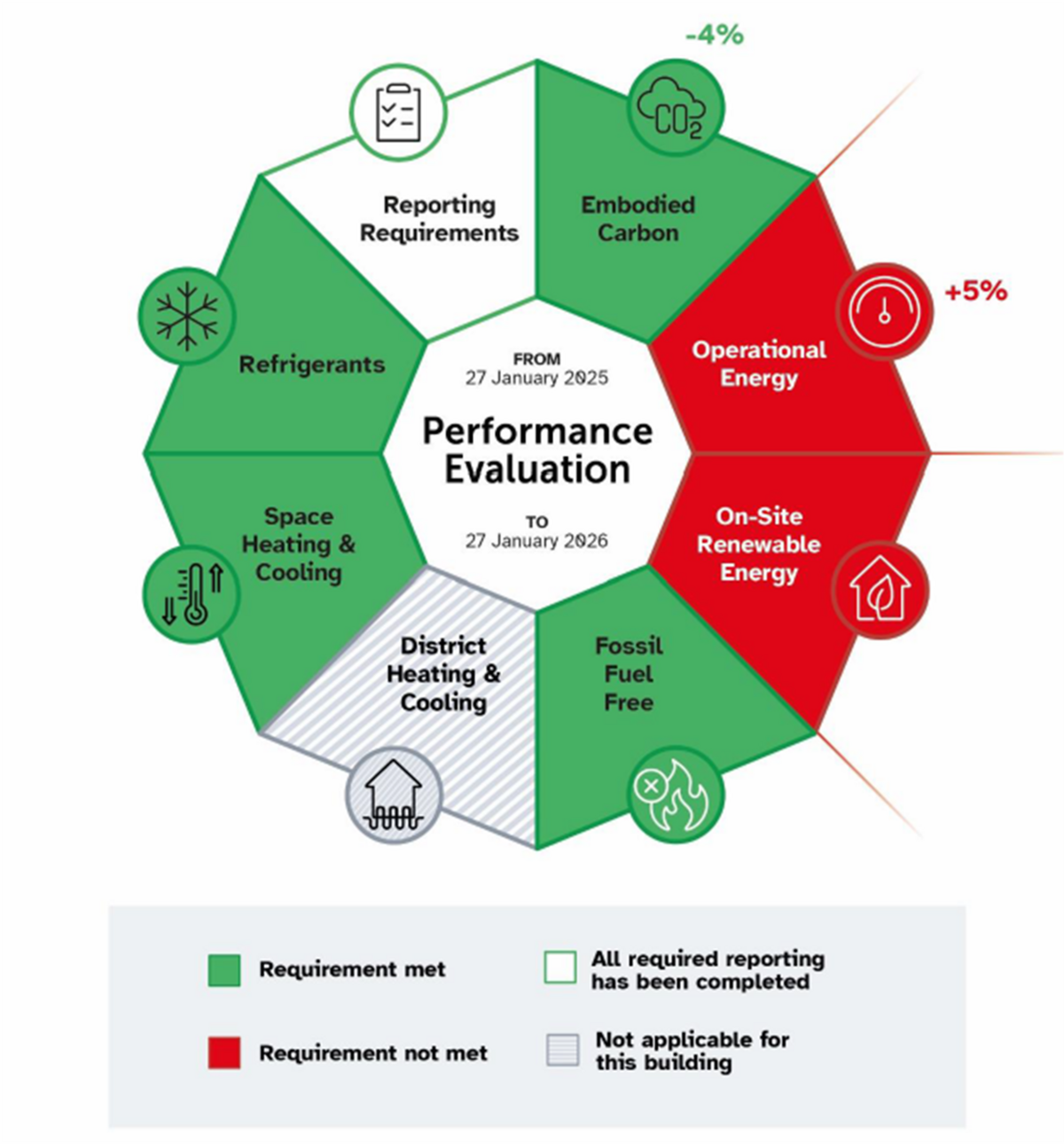
A crucial recent enhancement to the NZCBS is the introduction of a formal Performance Evaluation process. This allows a building to be assessed and given a report card (illustrated below) showing how closely it performs against applicable limits and other metrics.
This is an important development because it gives the market a way to assess progress, even where buildings may not yet meet every requirement for full NZCBS alignment.
Performance Evaluation is the perfect mechanism to upskill the supply chain and help building owners, investors, developers, and occupiers understand where the biggest gaps are. It can:
- underpin ambitions for all buildings to reach net zero in the future;
- support widespread adoption of the Standard;
- encourage transparency about building performance; and
- contribute to the evidence base that will inform the future development of the Standard, particularly as supply chains decarbonise and more real-world data becomes available.
Conclusions
The NZCBS and NABERS UK are helping to define what net zero building performance looks like. Together, they give the industry a clearer route towards more transparent, comparable and accountable net zero claims. They also highlight the areas where further progress is needed, particularly around embodied carbon, supply chain decarbonisation and measured post-occupancy performance evaluation.
BIP.Verco encourages all parties involved in UK new build and major refurbishment projects to become familiar with the NZCBS and commit to having their buildings assessed through the Performance Evaluation process.
We have been involved in the development of both the NZCBS and NABERS from the outset, so we're well placed to help you align to these standards. Read our Align to Net Sero Standards service document for more information.
Find out more about the service
We are here to help, so feel free to reach out with any questions on this topic. We’d be happy to chat with you.